The Cost Of Systemic Bad Governance: An Ultra-Dependent Independent Nation.
For a country most dependent on oil for revenue, we rarely celebrate when oil prices fall. And we certainly don't, when it rises. Falling prices bring little relief, as they mostly represent lost revenue for the government, keeping inflation flat at best. When oil prices rise, however, the consequences land swiftly, harshly, and without mercy.
This is the strange reality of life in an oil-producing nation like Nigeria.
An imbalance that looks less accidental and more structural, with each repeating pattern leaving us to shoulder unnecessary debt. Debt not caused by war or sanctions, which naturally deplete reserves, but by plain old, avoidable, bad governance.
Once again, we find ourselves facing rising fuel prices, threatening an already strained cost of living, and like most Nigerians, I ask, why does a conflict thousands of miles away have such an immediate impact on everyday life here?
Within days of this conflict, we’re hit with record-high fuel hikes, which ripple through transportation prices, food costs, local and foreign goods, and even utility bills.
Yet wages and salaries barely move.
This is the real cost of bad governance left unchecked for too long, policies that never seem to benefit the citizens who make up this nation, leaving us perpetually at the mercy of external forces.
Yes, the current administration may not be directly responsible for the Middle East conflict that is sending global oil prices soaring. But the prices we pay at the pump today are the direct result of its policies. We now have the opportunity to see those policies play out, not in some political utopia, but in stark reality, with these pressing questions:
- How is deregulating the gas and oil industry working out for us?
- What has been done to stop terrorism in the Middle Belt and beyond, which displaces communities critical to our food supply?
- What steps are being taken to make local production of finished goods more profitable, to reduce unnecessary imports?
- And how does this administration plan to handle the looming economic nightmare for Nigerians?
Our ultra-dependence on the global market means we are not just watching a war—we are hurtling toward multiple crises at once. And history offers little confidence that our government has the plans to cushion the blow.
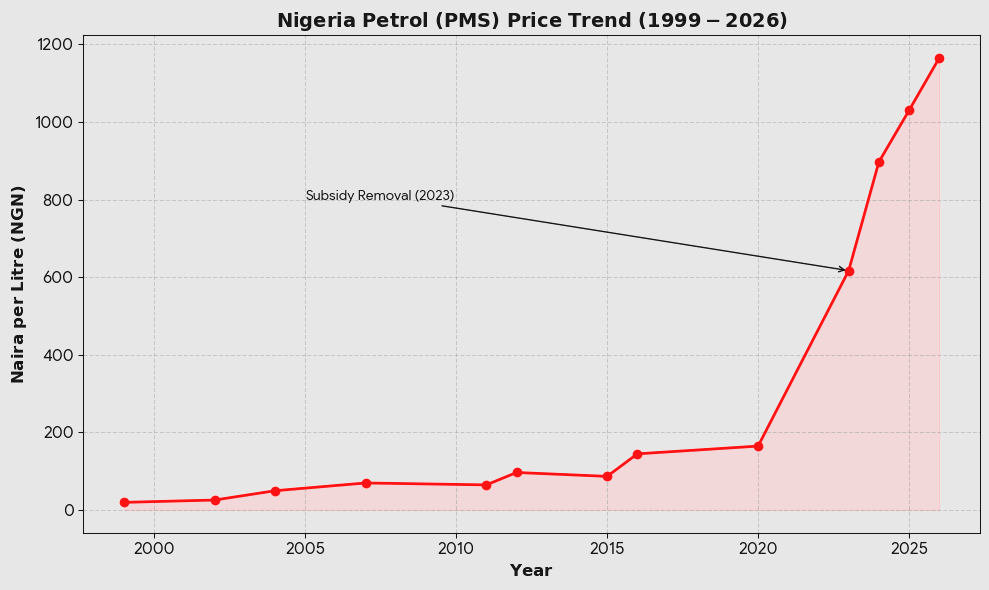
With the first major shock coming from subsidy removal, it’s hard to believe this administration has any meaningful plan to benefit citizens. Promises to reinvest subsidy savings into infrastructure, transportation, and social support systems remain unfulfilled, while fuel costs continue to surge.
With the Iran conflict showing no signs of an off-ramp, we are now facing at least four pressure points at once, exposing our vulnerabilities not just to bad governance domestically, but to the external markets:
Record-high petrol prices
The removal of fuel subsidies intensifies this pressure. With a deregulated oil market, the government no longer absorbs global shocks. Whatever happens in the global oil market hits our pumps instantly. The domestic shield citizens once enjoyed as Africa’s largest oil producer is gone, just in time for a war thousands of miles away to reach directly into our homes. Deregulating the most vital commodity in the economy without fixing the infrastructure that supports it is difficult to defend as sound policy.
Food supply disruption
Nigerian farmers are already struggling with violent conflict in key agricultural regions. Entire communities are displaced, forcing families to abandon farms simply to survive. Every administration condemns these attacks. And, unsurprisingly, the violence continues. We scroll past these stories, we feel bad, and then we move on. Now, the consequences are moving from farms to kitchens. Food price hikes may be the best-case scenario. Shortages are the worst.
Rising electricity tariffs
Roughly 80 percent of Nigeria’s grid power comes from gas-fired thermal plants. Under the Electricity Act of 2023, power companies can adjust tariffs to reflect costs. As global gas prices rise, electricity bills follow. Households continue to see increases across Band A and other tariff categories.
Higher shipping and freight costs
If new security costs or transit tolls emerge along major shipping routes, the charges are passed to shipping companies. But they don’t stay there. They flow through freight rates, landing costs, and eventually into the prices we pay for fuel, fertilizer, food...everything.
For months, many have criticized this administration for issues I felt did not directly affect the average citizen any worse than the last: debates about tribal representation, political persecution, even corruption. I often asked: What policy has directly affected my life? Clear answers were rare, so I gave these complaints little weight.
But now, we are witnessing the real-time consequence of one of this government’s major policies: the removal of fuel subsidies. A major economic decision implemented without the infrastructure to support it, without practical systems allowing citizens or private companies in the deregulated space to benefit. It echoes the same pattern of governance that has weakened our economy and strained society for decades.
If this unfolding reality is the true expression of the policy, the message is clear: this government is willing to transfer risk to citizens, reduce its responsibilities, and maintain centralized privileges. The blueprint is evident—a reckless push to shift responsibilities to the state through proposals like state policing, and to citizens through higher taxes, all while the cost of running the federal government continues to rise.
So, as we brace for tougher economic times ahead, the federal government, stacked with enough dead wood to light a century-long fire, appears largely unbothered.
I hope I’m wrong.