10k Nigerians Killed Since 2023: The Real Cost of Beef in Nigeria.
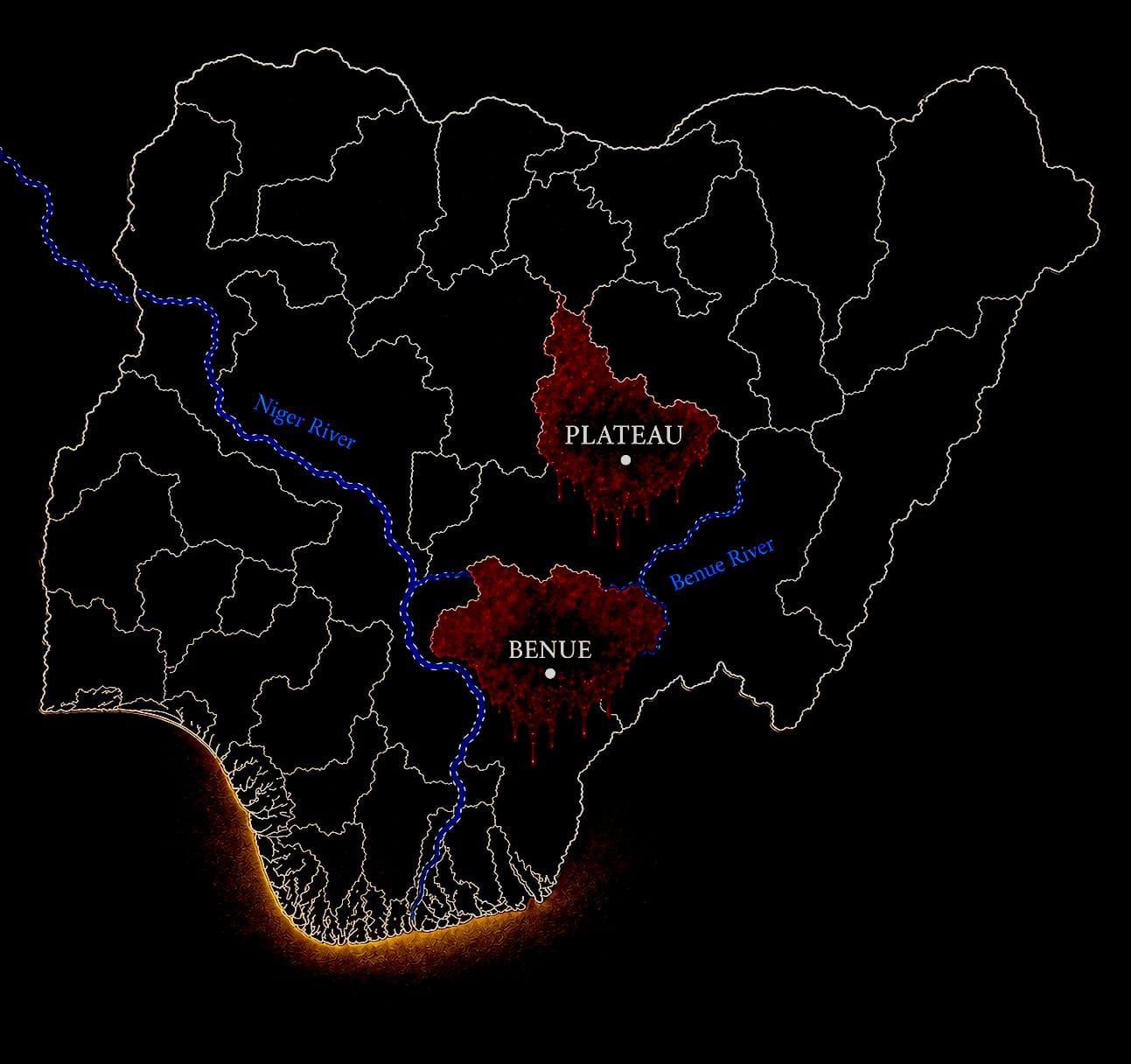
The bloody crisis in the Middle Belt has been going on for decades, with various causes assigned to it. From religious conflicts to tribal tensions, and now resources. It has gone on long enough that anyone can draw up conclusions and be partly right, because at the end of the day, it’s a mixture of everything.
But this latest round of conflict since 2018 is among the worst ever recorded in our country’s history, with rising death tolls, displacements, and sufferings. And all we’ve done in the last eight years is hope an administration would come along to fix the issue justly.
No such luck.
The idea of looking at this as religious persecution or tribal conflicts might be valid, but very disempowering.
Because how do you, as an average citizen, engage physically with such violence steeped in religion or tribe, without an all-out war?
No right-thinking Nigerian wants that. So we shake our heads and feel helpless.
But when we look at this through an economic lens, we suddenly see we have more power to help our brothers and sisters in the Middle-Belt much more than we realize.
Yes, it would require we make a few adjustments that aren’t exactly comfortable, but it’s nothing compared to the horrors these men, women, and especially children face daily.
But before we get to how we can exercise our economic power to help, here’s a summary of the crisis according to reports.
Back in 2018, Amnesty International released its landmark report, The Harvest of Death: Three Years of Bloody Clashes Between Farmers and Herders in Nigeria.
In that report, they sounded the alarm on a dramatic escalation of farmer–herder violence across Nigeria, especially in the Middle Belt.
Their findings were stark:
3,641 people were killed in just three years, with 57% of those deaths occurring in 2018 alone.
Hundreds of villages were attacked or burned, and thousands of people were displaced from their homes.
Amnesty International concluded that the crisis persisted largely because perpetrators were rarely punished, and urged the government to investigate attacks, prosecute offenders, strengthen security response, and compensate victims.
You’d think this report was enough to rush into action, but it clearly wasn't.
Most recently, in April 2026, Amnesty International reported that at least 10,217 people were killed and 672 villages sacked during the first two years of the current administration, from May 29, 2023, to May 29, 2025.
The escalation is unmistakable.
The jump from 3,641 deaths recorded between 2016 and 2018 to 10,217 deaths in just two years represents not merely an increase in casualties, but a dramatic acceleration in the pace of killing.
Violence that once unfolded over nearly three years is now happening in less than two and at more than twice the scale.
For clarity:
2016–2018 — The “Harvest of Death” Report documented 3,641 deaths over roughly 34 months across five major states, including Adamawa, Benue, Kaduna, Taraba, and Zamfara.
2023–2025 - The “Mounting Death Toll” findings documented 10,217 deaths in just a 24-month window following the change in federal administration, with fatalities heavily concentrated in Benue and Plateau states.
Since the release of the latest Amnesty findings less than a month ago, hundreds of additional killings continue to be reported weekly by local monitoring groups and community leaders.
Despite President Tinubu's April 2 assurance that "this experience will not repeat itself", massacres have since been recorded across at least six states: Plateau, Benue, Kaduna, Nasarawa, Zamfara, and Borno.
Dataset after dataset tells the same story.
The people from North Central to the Middle Belt, especially in Benue and Plateau states, are not merely facing insecurity in everyday terms.
At best, they are facing displacement and loss of access to their ancestral homes, living through two successive administrations that appear largely unresponsive to their suffering, often limited to issuing statements of condemnation without matching action to stop the violence.
In the worst cases, they are killed for their ancestral lands, which predate the modern Nigerian State.
We are now at a point where local and international bodies like Amnesty International are no longer simply urging investigation and arrests. In their latest report, they state that the government is effectively “abandoning its constitutional duty” to protect lives, pointing to a broader failure of accountability that has allowed continued impunity in the killings.
Something Nigerians, from all past patterns, know too well, "abandoning its constitutional duty".
The irony here remains in the fact that between 2023 and 2025 alone, Nigeria allocated more than ₦13.5 trillion to security.
Yet in that same period, killings in the Middle Belt reached record levels, and hundreds of communities were wiped off the map.
It’s clear to see that the killings, destruction, and land theft will continue until we, the citizens, do something.
Protests have shown little effect on the government. Neither has sustained bad press.
But one area where collective action remains possible is in cutting off the economic supply.
The traditional nomadic grazing system used to move cattle to the South is a key driver of land conflict and violence in the Middle Belt. Meanwhile, southern Nigeria remains heavily dependent on this system, with approximately 96% of beef supplied from the North.
Research published by outlets such as The ICIR highlights that while nomadic systems appear cheaper on paper for the herder, they carry significant externalized costs for the country.
The results?
The Northern Price of beef reflects the lower cost structure of open grazing systems with minimal capital input. Beef sells for about ₦3,400- ₦5,200 per kg, while a live cow costs roughly ₦450,000 – ₦800,00.
The Southern Price reflects a strained supply chain under pressure from insecurities and logistics. A kg of beef goes for about ₦7,000 -₦8,500, while a live cow can cost between ₦1.7 million- ₦2.5 million.
Lagos state illustrates this dependence most clearly. The state records over 7,000 cows consumed daily, accounting for about 70% of beef consumption in South-West Nigeria. Of an estimated 1.8 million cattle required annually to feed Lagos, the state produces only about 12,400 heads locally. This means nearly 99% of its beef comes from the north or neighboring Sahel countries.
Lagos residents spend an estimated ₦4 billion daily on red meat. As of April 2026, the price of a single cow in Lagos has hit as high as ₦2.5 million, up from ₦1.7 million in 2025.
In this sense, the idea that open grazing provides a cheaper system collapses under scrutiny, as its economic costs are absorbed across the entire country while its human costs are concentrated in the Middle Belt.
To summarize, this is a cycle that produces no real winners... but one we still have the power to correct.
So to play our part in correcting course, the solution isn't theoretical.
Stop buying open-grazed beef.
Apply market pressure on the government by demanding “Certified Ranch-Raised” beef and shifting consumption patterns towards systems that do not rely on violent land pressure at the expense of human life and dignity.
If you can afford an extra ₦1,000 on a kilo of meat, do it. You are effectively divesting from the violence in the Middle Belt and investing in a modernized, peaceful Nigeria.
Existing models like Ikun Dairy in Ekiti, Kamrum Farms in Oyo, Ohanaeze Farm in Enugu, or Maizube Farms in Niger prove that Nigeria can produce beef and milk without conflict over land. These ranches utilize fenced grazing and modern irrigation, demonstrating that the so-called "nomadic necessity" is largely a failure to modernize.
If you cannot access ranch-raised beef, consider alternative proteins such as fish and poultry.
This is not an ideal solution, but we aren’t operating in ideal circumstances anymore. And the cycle cannot continue without any form of resistance from the citizens.
Cut off the economic incentives that sustain the system until structural change is enforced.
This pattern of violence has already moved across regions.
It is the Middle Belt today.
The question is, do we wait until it moves further south?